by theEmother | Mar 9, 2017 | build a Mother of a Business, business ideas & thinking, entrepreneurial mothers, inspiring women, MEinc, so you think you're in business, women in business case studies
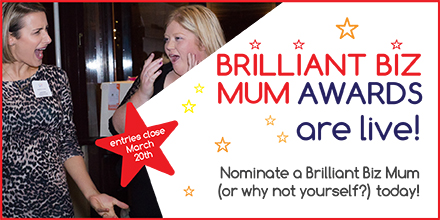
With a little over a week left to enter, I definitely want to see your nominations for this years Brilliant Biz Mum Awards!
There are 13 Awards categories covering everything from writing to social media to creative marketing to innovative products and more so it is time for you to step up and unveil the great work you have been doing over the past 12 months.
Which is why I am proud to be supporting as a guest judge in the Brilliant Biz Mum Awards and they are now open for you to nominate yourself or another amazing biz mum/s!
Prizes for the winners include coverage in Kid Magazine, a beautiful PAIRD necklace and a business package worth over $4,800.
Best of all, all the Awards are judged – no social media voting – so winners are Awarded on merit. Entries close March 20.
Check out the Awards by clicking the link below:
Link : http://www.motivatingmum.com/events/brilliant-biz-mum-awards
DO IT!
by theEmother | Feb 19, 2017 | build a Mother of a Business, business ideas & thinking, entrepreneurial mothers, inspiring women, MEinc, so you think you're in business, women in business case studies
I am proud to be supporting as a guest judge in the Brilliant Biz Mum Awards and they are now open for you to nominate yourself or another amazing biz mum/s!
There are 13 Awards categories covering everything from writing to social media to creative marketing to innovative products and more so I definitely want to see your nominations for this one!
Prizes for the winners include coverage in Kid Magazine, a beautiful PAIRD necklace and a business package worth over $4,800.
Best of all, all the Awards are judged – no social media voting – so winners are Awarded on merit. Entries close March 20.
Check out the Awards by clicking the link below:
Link : http://www.motivatingmum.com/events/brilliant-biz-mum-awards
by theEmother | Mar 25, 2016 | build a Mother of a Business, business ideas & thinking, MEinc, so you think you're in business, start with the end in mind

BIG question for you Business Owner is: how to orchestrate “Extended Leave” from my very own business?
That is, to carve out the time for you to enjoy perceived FREEDOM of business ownership and to look forward to going back to well established, thriving business when the time is right.
“Why would I want to do that?”, I hear you cry!
“I’ve structured my Business so that I can do both.”
“I’ll be OK, I can work around this surely.”
“How hard can it be, I’ll just take the work with me.”
Granted, there seems to be this unwritten, unspoken rule that goes along the lines of, if you are a business owner then how dare you think about taking time off for any reason, let alone for an extended holiday. Some would argue that wasn’t it because of this FREEDOM that many a business starts in the first place?
Seriously, whatever plans you put in place at the time of extended leave will generally work out in the end, for the most part. Were they ideal is the question explored after the fact, but then it’s too late. Instead, why not consider consciously locking out time to spend holidaying, knowing you do not have to worry about the day to day mechanics of the business for a set period of time?
Here’s what I know for sure, leaving what you want to happen to chance is quite often the worst way to think about how you want the months away to play out.
Hasty decisions made tardily in a stressful period may not be in yours and your business best interest. If real difficulties arise, sometimes the issues can trigger a throw-in-the-towel moment, resulting in walking away and just “shutting up shop”.
Let this not be you!
Appreciating that if this is extended leave #1, then you don’t know what you don’t know…yet. And even if it is break #2 or #3, one cannot be relied upon to be the same as the last, so newly formed considerations should apply each and every time.
From one who has been there, done that e.g: travelling on BIG adventures every two years after having taken over a business, building it to 7-figures and selling it after a 15 year reign whilst as a single mother…facilitating a structured way to have a chunk of time off and being paid regularly is critical.
Spending time seriously thinking through what proper measures to put in place to be able to enjoy being an adventurer and Business Ownership is a crucial step in being able to handle both. I guarantee the plotting and scheming you invest now will serve You, Partner, Business, Clients, Suppliers and the greater community so much better than if you do not…
So, firstly (given we are in planning stage), let’s take a moment to get clear on the current state of your Business by running it through (what I affectionately call) the “So You Think You’re In Business” Scorecard.
The final score not only gives you a snapshot of how you rate your business today but going through the process also reveals the opportunities and the reworks needed to finish your unfinished business in readiness for this next BIG holiday in your Life… if you’re up for the challenge that is?
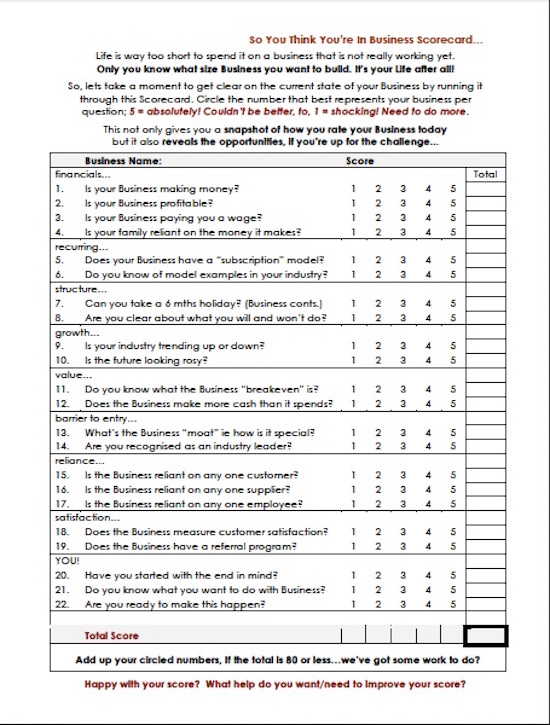
The point about doing this is to highlight, with a tactical focus:
• What needs to get done?
• By when?
• What necessary adjustments need to be made?
• Who can help?
• How to rollout?
So, why is this important?
When starting out in business, it is often touted that you should “start with the end in mind”. I for one talk about it all the time! However, whilst I completely understand that by bringing a BIG holiday into the mix it is not THE end of your business. Assuming you want to come back and step right in where you left off, you need to set it up that way.
Giving this a good hard think and deciding what to do may be influenced by the much-debated notion of why can’t I “have it all”? As we know, just because you can (potentially) doesn’t mean it’s the best thing to do, for you, at this particular time in your life.
What you choose to do with your business has to work for all concerned.
My intent for you is therefore, by going through this starting point exercise, as a line-in-the-sand eye opener, it enables you to acknowledge the gaps within your
Business and therefore investigate the ways and means to set up life whereby you can have as much of the “all” as makes sense for you.
Let’s face it, the most precious commodity a human has is that of TIME.
It cannot be banked, withdrawn and used at a later date. It is not refundable, no matter how hard you wish it to be. And you also know how long it has taken you to grow your business to where it is today. Taking all this into account, by being guided through with your pre-holiday that on enables you to comes to terms with how to combine Basking and Business.
If worse comes to worse and you just can’t see how it can all piece together, we can always talk about taking the Business to market and selling it… but let’s not be rush into anything just yet.
Wishing you all the best in whatever you decide to do.
by theEmother | Mar 20, 2016 | build a Mother of a Business, entrepreneurial mothers, inspiring women, MEinc, single parent l single mother
To all entrepreneurial mothers who double as a Financial Controller!
This role may just be the ideal job you have been looking for… are you able to?
- make strategic decisions based on financial data produced
- work as a senior member of a management team
- communicate at a high level with both team and colleagues
- utilise your industry experience in design, architecture, construction
- commute to an office in inner Melbourne
- command a pro-rata salary of $130,ooo+ p.a.
- do this working 15-20 hours per week
- contribute and do good work
If this is for you, email me at info@theentrepreneurialmother.com.au by March 15 with contact details and CV or equivalent.
Position Description – Finance Manager_LC
by theEmother | Mar 11, 2016 | build a Mother of a Business, business ideas & thinking, entrepreneur trends (past & present!), entrepreneurial mothers, events, inspiring women, Listen, MEinc, so you think you're in business, start with the end in mind, women in business case studies
Time to get onto it!
The Brilliant Biz Mum Conference & Awards is a celebration of amazing mums in business – by way of showing off their products and services, listening to their amazing stories and celebrating their achievements.
The Conference & Awards will be held on May 14th, 2016 featuring approx 40 stallholders, amazing speakers, workshops and networking galore in the day! The Awards night is a fun night of celebration and networking directly after the Conference – culminating in awarding 13 amazing mums in business as the best in their field.
The Awards
The Brilliant Biz Mum Awards are all judged – there is no social media voting – so all winners are determined based on merit.
The judging panel is made up of the Award sponsor (a Biz Mum who has experience within the field and is managing the category) and two guest judges.
The categories are:
- Best Life & Business Clarity sponsored by Fiona Redding of The Happiness Hunter
- Best Juggler sponsored by Pauline Delany of The Harmony Life Stylist
- Most Influential Brand sponsored by Annemarie Cross of annemariecross.com
- Best Service-Based Business sponsored by Rosie Shilo of Virtually Yours
- Best Innovative Product sponsored by Cath Connell of Spicycat Creative and Wholehearted Marketing
- Best Social Media Success Story sponsored by Loren Bartley of Impactiv8
- Most Creative Marketing on a Budget sponsored by Susie Campbell of Little Black Book Marketing
- Best Mum in Biz Boss sponsored by Natasha Gallardo of Working Mothers Connect
- Best Web Presence sponsored by Julie Allen of biz yourself
- Best Image for Business sponsored by Zahrina Robertson of Zahrina Photography & Video
- Writing Excellence Award sponsored by Sarah Garbuio of The Business Butler
- Best Community-Minded Mum sponsored by Melina Schamroth of m.a.d. woman
- MLM Superstar Award sponsored by Fran Pratt of Kiss to Sell & Arbonne
There is definitely at least one category you can be going for… just choose it and do it!
Details of the conference can be found here
http://www.motivatingmum.com/events/brilliant-biz-mum-conference

by theEmother | Jan 11, 2016 | build a Mother of a Business, business ideas & thinking, buy | sell websites, Buy a Mother of a Business, Online Strategy incl. www, so you think you're in business, start with the end in mind, the business model
Seth Godin (acclaimed author and teacher) says to start your first business this way:
- Begin with the smallest possible project in which someone will pay you money to solve a problem they know they have.
- Charge less than it’s worth and more than it costs you.
- Repeat
The beauty about doing so with an Online Business is that not only is it simple to do; it can be done far more cheaply than to go a more traditional route.
Don’t worry so much about the ‘online’ part. It is only a tool, a mechanism to reach people who need to know about you’re your business is doing. Instead, figure out how to create value. The online part will take care of itself.
Don’t quit your day job (whatever that means to you) or use all your savings. Start evenings and weekends. If you don’t want to have to start from scratch, buy a small online business to practice on. The best way to move from Learner to Practitioner is to DO stuff. Figure it out with small failures.
Doing so also helps you build a public reputation (which can remain online only). Build a good one, and be sure that you deserve it, and that it will hold up to scrutiny.
Obsessively specialize. No niche is too small if it’s yours.
Connect the disconnected.
Make money offline. If you can figure out how to create value face to face, it’s a lot easier to figure out how to do the same digitally. The web isn’t magic, it’s merely efficient.
Become the best in the world at something that people value. Easier said than done, worth more than you might think.
Hang out with people who aren’t looking for shortcuts. Learn from them. Find and pay for advice that has not only credentials but also a robust track record.
Fail. Fail often and fail cheaply. This is the very best gift the web has given to people who want to bootstrap their way into a new business.
Make money in the small and then relentlessly scale.
Don’t chase yesterday’s online fad.
Think big, act with intention and don’t get bogged down in personalities. If it’s not on your agenda, why are you wasting time on it?
Learn. Ceaselessly. Learn to code, to write persuasively, to understand new technologies, to bring out the best in a team (especially if offshore), to find underused resources and to spot patterns.
This is not a zero sum game. The more you add to your community, the bigger your piece gets.
Here’s a novel first seven steps to get you going:
- Pick your Topic
Create a strategic map of all that is going on within that topic and start checking for gaps and patterns
- Keywords
Concentrating on both the industry players and their likely customers, create a list of keywords that is used to find them and are relevant to your topic
- Search
Using these keywords, start searching and note what you find. Again what are the questions being asked that does not appear to have answers?
- Top 50 pages
Record what the top 50 pages are that come up for the questions. Explore them for the answers being sought. What’s missing?
- Extract contact details
Feed into your database/spreadsheet
- Create an “offer”, with the view to discussing what’s missing with the top 50, highlighting how you are the one to assist in plugging this gap (and to project manager it for payment)
- Rinse and repeat
Following steps like these will enable you to potentially play in a space you may be more familiar in i.e. the more traditional business, and together, craft and execute an online business model that you has you part of the action.
And it certainly opens the door to a useful conversation about whether your personal goal is useful, your strategy is appropriate and your tactic is coherent and likely to cause the change sought.
In your offer, address:
What’s it for?
When it works, will we be able to tell?
What’s it supposed to do?
Who is it for?
What specific group is this designed to resonate with?
What does this remind you of?
Who has tried this before?
Is it as well done?
What’s the call to action?
Is there a moment when you are clearly asking people to do something?
Show this to ten strangers. Don’t say anything. What do they ask you?
Now, ask them what the material is asking them to do.
What is the urgency?
Why now?
Your job is not to answer every question; your job is not to close the sale. The purpose of this work is to amplify interest, generate interaction and spread your idea to the people who need to hear it, at the same time that you build trust.
You will rarely achieve this with one fell swoop, so be prepared to drip your way through countless swoops until you’ve earned the privilege of engaging with the audience you seek and them seeing the value in what you’re proposing.
As simple as Seth’s advice is, it is also extremely powerful. Follow it, together with the steps outlined and you will be well on your way.
To talk to me about this and any other business question you have on your mind, please contact me via email: dhall@businessbrokers.com.au.